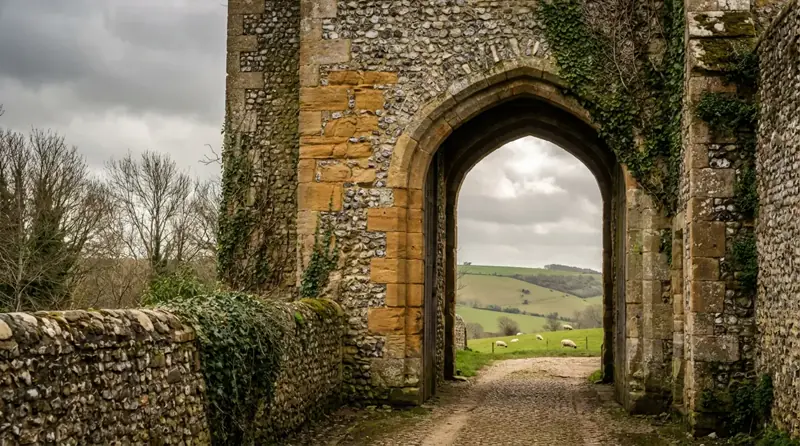
West Sussex has more historic places to visit per square mile than almost anywhere else in England. Over 3,000 listed buildings, six castles, two Roman sites, and a working Victorian museum sit within a county barely 70 miles wide. Whether you want knights in armour at Arundel, Roman mosaics at Fishbourne, or 50 rescued Tudor farmhouses at Weald & Downland, you will find it here. This guide covers the best, with honest notes on what to expect, how much it costs, and what works best for families.
Arundel Castle
The most complete medieval castle in the south of England, Arundel Castle has been the home of the Dukes of Norfolk for nearly a thousand years. The main castle building dates from 1067, rebuilt and expanded over the centuries into a spectacular hilltop pile overlooking the Arun valley. It is very much still a family home, which gives it an atmosphere that purpose-built heritage sites lack.
What to see: the Keep and Norman motte (oldest part of the site), the State Rooms (portraits, furniture, armour), the Victorian Chapel of the Holy Trinity, and the castle grounds with formal gardens and a grass amphitheatre used for seasonal events. The Collector Earl's Garden is one of the finest recreated 17th-century gardens in England.
For families, the castle runs seasonal activity events including archery, jousting displays, and summer trails. The Bevis Tower, which you can climb for views across to the coast, is a highlight for older children.
Entry (2025 prices): Adults £28, children (5–16) £16, under-5s free, family (2 adults + 2 children) £74. Castle and grounds combined ticket.
Key Information
Top tip: The interior is grand but not fully interactive. For primary-age children, the grounds and seasonal events add the most value. Under-5s will enjoy the space to run and the ducks on the moat more than the State Rooms.
Fishbourne Roman Palace
The largest known Roman residence in Britain, discovered only in 1960 when a builder hit a water main during a housing development. The Roman building that emerged from that accident turned out to be a palace from around 75 AD, with mosaic floors covering an area the size of three football pitches. The most famous mosaic, Cupid on a Dolphin, is one of the best-preserved examples of Roman floor mosaic in the country.
The museum is excellent: accessible, well-interpreted, and genuinely surprising. A full working Roman garden has been replanted based on evidence from the original excavation. The mosaics are kept under a modern roofed building, which makes this a good option for wet days.
Entry (2025 prices): Adults £13.60, children (5–17) £8.20, family (1 adult + 3 children or 2 adults + 2 children) £35.20. Managed by Sussex Archaeological Society.
Key Information
Top tip: Best suited to children aged 7 and up who can engage with the history. Younger children enjoy the garden and the hands-on activity area, but may find the mosaic galleries less absorbing. Allow 2 hours minimum.
Petworth House and Park
A National Trust property of rare grandeur: a 17th-century mansion crammed with one of the finest art collections held by the Trust, including works by Turner, Van Dyck, and Reynolds. Turner painted here repeatedly, drawn by the light across the 1,000-acre deer park that surrounds the house.
The house itself is formal and suited to older children with an interest in history or art. But the real draw for families is the park, which is free to access and one of the most beautiful landscapes in West Sussex. Fallow and red deer roam freely throughout. The sunsets from the high point of the park, looking west over the Rother valley, are exceptional.
Entry (2025 prices): House and garden: Adults £20, children £10, family £50. Park is free and open year-round, dawn to dusk.
Key Information
Top tip: The house is not particularly child-friendly inside, but the park more than compensates. If the art collection is not the draw, visit on a morning and walk the park without entering the house.
Weald & Downland Living Museum
Over 50 historic buildings, spanning more than a thousand years from a Saxon dwelling to a Victorian farmstead, all relocated from their original sites across Sussex, Surrey, and Hampshire to a 40-acre site at Singleton, six miles north of Chichester. The concept is simple and quietly extraordinary: instead of letting threatened historic buildings be demolished, move them intact.
You can walk through a 13th-century farmstead, explore a Tudor market hall, watch a working watermill grind flour, and see a rare example of a medieval ploughman's cottage. Many buildings are open to enter, with demonstrations running through the season. It is also the filming location for The Repair Shop on BBC, which delights many visitors.
Entry (2025 prices): Adults £19.50, children (4–16) £11, under-4s free, family (2 adults + up to 4 children) £55. Annual membership available.
Key Information
Top tip: One of the best family days out in West Sussex, especially for under-10s. Allow a full day. The site is largely outdoors and hilly in places; bring waterproofs and wear good shoes.
Amberley Museum
Often overlooked in favour of its grander neighbours, Amberley Museum is one of the most rewarding industrial heritage sites in the south of England. Set in a 36-acre chalk quarry in the village of Amberley, the museum preserves and operates working examples of industrial machinery, transport, and craftwork from the 19th and 20th centuries.
Highlights include a narrow-gauge railway that operates daily through the season, a working brickworks, a vintage bus yard, and demonstrations of traditional crafts including printing, woodworking, and basket-making. A functioning telephone exchange from the 1920s is particularly unusual.
Entry (2025 prices): Adults £16, children (5–16) £9, under-5s free, family (2 adults + up to 3 children) £45.
Key Information
Top tip: The narrow-gauge railway ride is the headline act for children, but the working craft demonstrations hold attention surprisingly well. Best from May to September when the full programme runs.
Bramber Castle
A ruined Norman castle with a sharply leaning wall segment that makes it immediately distinctive. Originally built shortly after the Conquest by William de Braose, it was damaged in the Civil War and left to decline. What remains is atmospheric rather than spectacular: an 80-foot motte, fragments of the keep wall, and views south towards the Adur valley.
Entry is free and it is managed by English Heritage. A short walk from the castle leads to St Mary's House and Gardens, one of the best-preserved timber-framed houses in England (separate admission applies).
Entry: Free. Managed by English Heritage.
Key Information
Top tip: Best combined with a walk along the Adur valley or a visit to nearby Steyning. The ruin itself takes 20 minutes to explore. St Mary's House next door is worth the additional entrance fee for anyone interested in medieval domestic buildings.
Standen House
A National Trust Arts and Crafts house built in the 1890s, designed by Philip Webb for a prosperous London solicitor as a country retreat. It is the most complete Arts and Crafts interior in England: William Morris fabrics, original light fittings, and rooms that have changed remarkably little in 130 years.
Standen is quieter and less visited than Petworth or Arundel, which makes it a more relaxed experience. The gardens drop steeply down the Sussex Weald with views north across the High Weald. The tea room in the stable block is one of the better National Trust cafes in the county.
Entry (2025 prices): Adults £16.50, children £8.25, family £41.25. National Trust members free.
Key Information
Top tip: More suited to older children and adults with an interest in design or decorative arts. Younger children may be less engaged inside, but the garden and estate walks are a good combination with the house tour.
Parham House and Gardens
An Elizabethan manor house in the middle of a working deer park, with the South Downs providing the backdrop. Parham has a more personal, less curated feel than the National Trust properties: you walk through rooms that still read as a family home, with portraits accumulated over four centuries and the slightly chaotic quality of somewhere genuinely lived-in.
The gardens include a four-acre walled garden, one of the largest in Sussex, with spectacular summer displays. Parham also runs Elizabethan-themed events through the season, which are worth planning around.
Entry (2025 prices): House and garden: Adults £18, children (3–16) £9, under-3s free. Gardens only: Adults £10, children £5.
Key Information
Top tip: The open day schedule is less predictable than other venues on this list. Check the website carefully before visiting. The deer park is free to walk through at other times via public footpaths.
Uppark House and Garden
A late-17th-century hilltop house on the South Downs, managed by the National Trust. Uppark is unusual in having survived a major fire in 1989 largely intact: the house was painstakingly restored over five years to look exactly as it did before. H. G. Wells's mother worked here as a housekeeper in the 1880s; Wells himself spent time in the basement and the experience informed The Time Machine.
The restored interior is impressive, but the setting is the real draw: the South Downs landscape to the front, with a ha-ha keeping the flock out of the formal lawns.
Entry (2025 prices): Adults £14.50, children £7.25, family £36.25. National Trust members free.
Key Information
Top tip: A more specialist interest than Petworth or Standen. The H. G. Wells connection is well presented and interesting for older children. The landscape walk around the estate makes a good half-day.
Boxgrove Priory
A fragment of a far larger Norman priory church, with a 12th-century painted ceiling in the choir that is one of the most remarkable things you can see for free in West Sussex. The priory was largely demolished at the Dissolution, but the chancel survived as the village parish church and contains exceptional Norman and Early English architecture.
Boxgrove is also a significant archaeological site: human remains discovered nearby in 1993 are the oldest human fossils found in Britain, dating to approximately 500,000 years ago.
Entry: Free. Parish church, open daily.
Key Information
Top tip: Primarily of interest to adults and older children with an interest in church architecture or history. The painted ceiling requires binoculars or a zoom lens to fully appreciate. The archaeological site itself is not publicly accessible.
Castles and Historic Sites in West Sussex: Quick Comparison
| Site | Entry cost (adult) | Best for | Open year-round? |
|---|---|---|---|
| Arundel Castle | £28 | All ages, medieval history | No (Mar–Oct) |
| Fishbourne Roman Palace | £13.60 | Ages 7+, Roman history | Yes |
| Petworth House and Park | £20 (park free) | Art lovers, park walks | Park yes, house no |
| Weald & Downland Museum | £19.50 | Families, all ages | Feb–Nov |
| Amberley Museum | £16 | Families, ages 4+ | Mar–Nov |
| Bramber Castle | Free | Short visit, walkers | Yes |
| Standen House | £16.50 | Design and arts interest | Feb–Oct |
| Parham House | £18 | Elizabethan history | Apr–Oct |
| Uppark House | £14.50 | South Downs setting, H G Wells | Feb–Oct |
| Boxgrove Priory | Free | Adults, church architecture | Yes |
Getting the Most From a Historic Day Out in West Sussex
Plan around opening seasons. Most of the major houses and castles close November to February. If you are visiting in winter, Fishbourne Roman Palace (open year-round), Bramber Castle (free, outdoor), and Boxgrove Priory (free, always open) remain accessible. Amberley Museum and Weald & Downland operate reduced schedules in winter, so check ahead.
National Trust membership pays for itself if you visit three or more National Trust properties in a year. Petworth, Standen, and Uppark are all Trust properties, so a family membership covers all three visits plus parking.
For more ideas across the county, see our guide to things to do with teenagers in West Sussex and our Easter events guide if you are planning a visit over the holidays.